<?xml version="1.0" encoding="utf-8"?><feed xmlns="http://www.w3.org/2005/Atom" ><generator uri="https://jekyllrb.com/" version="3.10.0">Jekyll</generator><link href="https://www.luigidonadel.com/feed.xml" rel="self" type="application/atom+xml" /><link href="https://www.luigidonadel.com/" rel="alternate" type="text/html" /><updated>2026-04-19T10:24:47+00:00</updated><id>https://www.luigidonadel.com/feed.xml</id><title type="html">Luigi Donadel</title><subtitle>Senior Software Engineer. Entrepreneur. Building stuff.</subtitle><entry><title type="html">Anapana</title><link href="https://www.luigidonadel.com/anapana/" rel="alternate" type="text/html" title="Anapana" /><published>2026-01-01T10:00:00+00:00</published><updated>2026-01-01T10:00:00+00:00</updated><id>https://www.luigidonadel.com/anapana</id><content type="html" xml:base="https://www.luigidonadel.com/anapana/"><![CDATA[<p><img src="/assets/images/projects/anapana/cover.png" alt="Anapana" /></p>

<h3 id="overview">Overview</h3>

<p>Anapana is Italy’s first mindfulness and meditation app built entirely in Italian — not translated, not adapted, but designed from scratch for Italian speakers. The app helps people train their minds to be present through guided meditations, breathing sessions, and a structured 30-day program, all grounded in neuroscience and mindfulness research.</p>

<p>My role here is twofold: I lead the <strong>mobile development</strong> of the product (iOS and Android), and I also own the <strong>growth side</strong> of the app — from acquisition strategy to retention and monetization experimentation.</p>

<h3 id="my-role">My role</h3>

<p><strong>Mobile Development</strong>
I’m responsible for the full mobile experience across both platforms. This means owning the architecture, the meditation player, session flows, subscription integration, and everything in between. The codebase is built for performance and reliability — because when someone is trying to meditate, the last thing they should be thinking about is their app.</p>

<p><strong>Growth</strong>
Beyond engineering, I manage the growth function: analyzing user behavior, running experiments on onboarding and paywall flows, optimizing conversion across the subscription funnel (quarterly, semi-annual, annual), and identifying the levers that actually move retention. It’s the part of the product where data and intuition have to work together.</p>

<h3 id="what-the-app-offers">What the app offers</h3>

<ul>
  <li><strong>30-day structured program</strong> — builds a meditation habit from scratch, no prior experience needed</li>
  <li><strong>Guided meditations</strong> — expert-led sessions on focus, stress, and awareness</li>
  <li><strong>Breathing exercises</strong> — practical tools for day-to-day calm</li>
  <li><strong>Personalized practice</strong> — adapts to the user’s experience level and goals</li>
  <li><strong>Science-backed</strong> — developed with input from mindfulness, neuroscience, and psychology experts</li>
</ul>

<h3 id="links">Links</h3>

<ul>
  <li><a href="https://anapana.it">anapana.it</a></li>
</ul>]]></content><author><name>donadev</name></author><category term="project" /><category term="ios" /><category term="android" /><category term="react-native" /><category term="mindfulness" /><category term="growth" /><summary type="html"><![CDATA[Italy's first native mindfulness app. I lead mobile development and own the growth side of the product.]]></summary><media:thumbnail xmlns:media="http://search.yahoo.com/mrss/" url="https://www.luigidonadel.com/assets/images/projects/anapana/cover.png" /><media:content medium="image" url="https://www.luigidonadel.com/assets/images/projects/anapana/cover.png" xmlns:media="http://search.yahoo.com/mrss/" /></entry><entry><title type="html">SEO Wrap</title><link href="https://www.luigidonadel.com/seowrap/" rel="alternate" type="text/html" title="SEO Wrap" /><published>2025-12-01T10:00:00+00:00</published><updated>2025-12-01T10:00:00+00:00</updated><id>https://www.luigidonadel.com/seowrap</id><content type="html" xml:base="https://www.luigidonadel.com/seowrap/"><![CDATA[<p><img src="/assets/images/projects/seowrap/cover.png" alt="SEO Wrap" /></p>

<h3 id="overview">Overview</h3>

<p>SEO Wrap is my own project — born from a simple observation: Google Search Console is full of valuable data, but making sense of it (let alone sharing it) is tedious. So I built something that turns your entire year of search performance into 8 beautiful, shareable visual stories, inspired by the format popularized by Spotify Wrapped.</p>

<p>Connect your Search Console account, wait 30 seconds, and get a personalized SEO year-in-review covering everything from your top queries and champion pages, to geographic reach, device breakdown, hidden insights, and monthly trends.</p>

<p>The whole experience is free, requires no credit card, and zero technical setup. It’s designed for website owners and marketers who want to actually understand and communicate their SEO performance — not just stare at spreadsheets.</p>

<h3 id="recognition">Recognition</h3>

<ul>
  <li>🏆 <strong>#1 Product of the Day</strong> on OpenHunts</li>
  <li>🥈 <strong>#2 Product of the Day</strong> on PeerPush</li>
</ul>

<h3 id="what-it-shows">What it shows</h3>

<ul>
  <li><strong>Overview</strong> — total clicks, impressions, and year-over-year growth</li>
  <li><strong>Top queries</strong> — the searches that drove the most traffic</li>
  <li><strong>Champion pages</strong> — best-performing URLs with detailed stats</li>
  <li><strong>Geographic reach</strong> — where your audience comes from</li>
  <li><strong>Device breakdown</strong> — mobile, desktop, tablet split</li>
  <li><strong>Monthly trends</strong> — how performance evolved through the year</li>
  <li><strong>Hidden insights</strong> — surprising discoveries in the data</li>
  <li><strong>Year-end summary</strong> — everything in one shareable card</li>
</ul>

<h3 id="why-i-built-it">Why I built it</h3>

<p>I wanted a faster, more visual way to review and present SEO progress — both for my own projects and when working with others. Building SEO Wrap also gave me the chance to go deep on the Google Search Console API, data visualization, and the challenge of making complex analytics feel human and accessible.</p>

<h3 id="links">Links</h3>

<ul>
  <li><a href="https://seowrap.now">seowrap.now</a></li>
</ul>]]></content><author><name>donadev</name></author><category term="project" /><category term="seo" /><category term="saas" /><category term="nextjs" /><category term="google-search-console" /><summary type="html"><![CDATA[Your SEO year, visualized like Spotify Wrapped. Transforms Google Search Console data into 8 shareable stories.]]></summary><media:thumbnail xmlns:media="http://search.yahoo.com/mrss/" url="https://www.luigidonadel.com/assets/images/projects/seowrap/cover.png" /><media:content medium="image" url="https://www.luigidonadel.com/assets/images/projects/seowrap/cover.png" xmlns:media="http://search.yahoo.com/mrss/" /></entry><entry><title type="html">Voice Journaling Revolution: Why Speaking Your Thoughts Beats Writing Them</title><link href="https://www.luigidonadel.com/voice-journaling-revolution/" rel="alternate" type="text/html" title="Voice Journaling Revolution: Why Speaking Your Thoughts Beats Writing Them" /><published>2025-08-25T10:00:00+00:00</published><updated>2025-08-25T10:00:00+00:00</updated><id>https://www.luigidonadel.com/voice-journaling-revolution</id><content type="html" xml:base="https://www.luigidonadel.com/voice-journaling-revolution/"><![CDATA[<h2 id="the-traditional-journaling-paradox">The Traditional Journaling Paradox</h2>

<p>I’ve always been told that writing by hand is the best way to journal. The idea is that forming letters on paper creates some special cognitive pathway that helps you think more clearly and organize your thoughts better. That’s why every journaling app out there is built around writing—they assume that to really reflect on your life, you need to sit down and carefully put your feelings into words on paper.</p>

<p>But here’s what I’ve been wondering lately: what if that’s not true for everyone? What if some of us think better when we talk rather than when we write? What if we could flip the whole journaling thing on its head and use our voice instead?</p>

<h2 id="my-personal-discovery">My Personal Discovery</h2>

<p>This all started with a simple realization I had about myself: I’m way better at expressing my emotions and working through complex thoughts when I’m talking out loud than when I’m trying to write them down. It’s like there’s this direct line from my brain to my mouth that just works better than the one to my hands.</p>

<p>I started noticing this when I’d try to journal about something difficult that happened during the day. I’d sit there with a pen and paper (or more often, my phone), and I’d struggle to get the words out. But then I’d call a friend and suddenly I’m explaining the whole situation perfectly, with all the nuance and emotion that I couldn’t capture in writing.</p>

<p>The thing is, writing has these built-in barriers that I never really thought about before. You have to think about spelling, grammar, sentence structure—all this stuff that has nothing to do with what you’re actually feeling. It’s like trying to have a deep conversation while also solving a puzzle. Sometimes the puzzle-solving part takes over, and you lose the emotional thread you were trying to follow.</p>

<h2 id="why-voice-is-so-much-richer">Why Voice is So Much Richer</h2>

<p>Here’s the thing about voice that I find fascinating: when you talk, you’re not just saying words. You’re communicating through your tone, your rhythm, how fast or slow you’re speaking, the little pauses and stutters—all of this stuff that writing completely strips away.</p>

<p>I’ve noticed that when I’m talking about something I’m excited about, my voice gets higher and I talk faster. When I’m struggling with something, I slow down and my voice gets quieter. When I’m not sure about something, I’ll pause or say “um” a lot. These are all clues about what’s really going on in my head that I would never capture if I was just writing.</p>

<p>And here’s something else I’ve realized: those little mistakes and corrections we make when we’re talking? The “um”s and “uh”s and mid-sentence corrections? Those actually tell you something about what’s happening in your brain. When I’m writing, I edit all that stuff out, but when I’m talking, it’s all there—the raw, unfiltered version of my thinking process.</p>

<h2 id="the-beauty-of-unfiltered-thoughts">The Beauty of Unfiltered Thoughts</h2>

<p>One of the things I love most about voice journaling is that it captures your thoughts exactly as they happen. When you’re talking, you don’t have time to think “should I say this?” or “how should I phrase this?”—you just speak. And what comes out is often the most honest version of what you’re thinking.</p>

<p>I’ve found that when I try to write about something, I end up editing myself before I even get the words down. I’ll think “that sounds stupid” or “I should rephrase that” and end up with something that’s not really how I feel. But when I’m talking, I can’t do that. The words just come out, and they’re usually more honest and more revealing than anything I could write.</p>

<p>And here’s the cool part: when you do try to correct yourself while talking, the original thought is still there in the recording. It’s like having a complete picture of your thinking process, including all the detours and corrections. This has been incredibly valuable for me—I can see patterns in how I think that I never would have noticed if I was just reading my written journal entries.</p>

<h2 id="building-thinkaloud-my-solution">Building ThinkAloud: My Solution</h2>

<p>After months of thinking about this problem, I decided to build something that would let me journal the way I actually think—through voice. That’s how <strong><a href="https://www.thinkaloud.app">ThinkAloud</a></strong> was born.</p>

<p>The idea is simple: you press a button and start talking. As you speak, your words get transcribed in real-time, so you can see your thoughts materialize on screen. But it’s not just a voice recorder—the app actually analyzes what you’re saying and asks you questions to help you dig deeper into your thoughts.</p>

<p>I’ve been working on this for a while now, learning about speech recognition technology and how to make sense of the patterns in our speech. It’s been a fascinating journey, and I’m excited about how it’s turning out.</p>

<p><img src="/assets/images/blog/thinkaloud-screenshot.png" alt="ThinkAloud App Interface, Record" />
<img src="/assets/images/blog/thinkaloud-screenshot2.png" alt="ThinkAloud App Interface, Reflect" /></p>

<p><em>Here’s what the app looks like—you can see the real-time transcription happening as you speak</em></p>

<h2 id="why-voice-journaling-works-better-for-me">Why Voice Journaling Works Better (For Me)</h2>

<p>After using both methods for a while, I’ve noticed some clear differences between voice and written journaling. Here’s what I’ve found:</p>

<h3 id="the-natural-flow">The Natural Flow</h3>
<p>When I’m talking, my thoughts just flow. There’s no stopping to think about spelling or grammar or how to structure a sentence. It’s like having a conversation with myself, and the words come out exactly as I’m thinking them.</p>

<h3 id="capturing-the-full-picture">Capturing the Full Picture</h3>
<p>Writing only captures the words, but voice captures so much more. I can hear in my recordings when I’m excited about something (my voice gets higher and faster), when I’m struggling (I slow down and get quieter), and when I’m not sure about something (lots of pauses and “um”s). This gives me a much richer picture of what was really going on in my head.</p>

<h3 id="no-self-editing">No Self-Editing</h3>
<p>This is a big one for me. When I’m writing, I’m constantly editing myself—”that sounds stupid,” “I should rephrase that,” “that’s not quite right.” But when I’m talking, I can’t do that. What comes out is what I’m actually thinking, not what I think I should be thinking.</p>

<h3 id="speed-and-efficiency">Speed and Efficiency</h3>
<p>I can capture a day’s worth of thoughts in about 10 minutes of talking. If I tried to write all that down, it would take me an hour or more. Plus, I’d probably give up halfway through because writing is just more work for me.</p>

<h2 id="what-thinkaloud-actually-does">What ThinkAloud Actually Does</h2>

<p>So here’s how the app works under the hood:</p>

<p><strong>Real-Time Transcription</strong>: As you’re talking, your words appear on screen almost instantly. It’s pretty magical to watch your thoughts materialize as you speak them.</p>

<p><strong>Smart Analysis</strong>: The app doesn’t just transcribe—it actually tries to understand what you’re saying. It looks for patterns in your speech, emotional themes, and topics that come up frequently.</p>

<p><strong>Guided Questions</strong>: Based on what you’ve said, it asks you questions to help you think deeper about certain topics. Like if you mention feeling stressed about work, it might ask “What specifically about work is causing this stress?” or “When did you first notice this feeling?”</p>

<p>I’m still working on making this part better, but it’s already been really helpful for me. Sometimes the questions it asks make me realize things I hadn’t thought about before.</p>

<h2 id="why-this-matters">Why This Matters</h2>

<p>I think the reason this is so important is that we’ve been assuming everyone thinks the same way. We’ve built all these journaling tools around writing, but what if some of us just aren’t wired that way?</p>

<p>I know plenty of people who are amazing writers and love journaling with pen and paper. But I also know people like me who think better when they’re talking. We shouldn’t have to force ourselves into a writing mold just because that’s what’s available.</p>

<h2 id="what-ive-learned">What I’ve Learned</h2>

<p>Building ThinkAloud has taught me a few things:</p>

<p><strong>People are different</strong>: What works for one person might not work for another, and that’s okay.</p>

<p><strong>Technology can adapt to us</strong>: Instead of us adapting to technology, we can build tools that work the way we naturally think.</p>

<p><strong>Voice is powerful</strong>: There’s something really special about capturing our thoughts exactly as they happen, without the filter of writing.</p>

<h2 id="wrapping-up">Wrapping Up</h2>

<p>I’m not saying voice journaling is better than writing—I’m saying it’s different, and for some of us, it might be exactly what we need. <strong><a href="https://www.thinkaloud.app">ThinkAloud</a></strong> is my attempt to give people like me a way to journal that actually works with how our brains are wired.</p>

<p>If you’ve ever struggled with traditional journaling or felt like you couldn’t quite capture your thoughts in writing, maybe give voice a try. You might be surprised by how much more natural it feels.</p>

<hr />

<p><em>This is just my experience and what I’ve learned along the way. I’d love to hear from others who’ve tried voice journaling or who have similar struggles with written journaling.</em></p>]]></content><author><name>donadev</name></author><category term="blog" /><category term="voice-journaling" /><category term="personal-development" /><category term="mental-health" /><category term="productivity" /><category term="technology" /><category term="journaling" /><category term="voice-to-text" /><category term="thinkaloud" /><summary type="html"><![CDATA[Discover how voice journaling with ThinkAloud can transform your self-reflection process and help you express emotions more authentically than traditional writing.]]></summary><media:thumbnail xmlns:media="http://search.yahoo.com/mrss/" url="https://www.luigidonadel.com/assets/images/blog/voice-journaling.jpg" /><media:content medium="image" url="https://www.luigidonadel.com/assets/images/blog/voice-journaling.jpg" xmlns:media="http://search.yahoo.com/mrss/" /></entry><entry><title type="html">Thinkaloud</title><link href="https://www.luigidonadel.com/thinkaloud/" rel="alternate" type="text/html" title="Thinkaloud" /><published>2025-07-19T16:33:00+00:00</published><updated>2025-07-19T16:33:00+00:00</updated><id>https://www.luigidonadel.com/thinkaloud</id><content type="html" xml:base="https://www.luigidonadel.com/thinkaloud/"><![CDATA[<p><img src="/assets/images/projects/thinkaloud/cover.png" alt="Thinkaloud" /></p>

<h3 id="overview">Overview</h3>

<p>Thinkaloud is a journaling app I developed during the summer of 2025 that addresses a common problem I’ve personally experienced with traditional journaling. While I’m a big fan of journaling, I’ve always found that written journaling is incredibly time-consuming and mentally demanding. I was looking for a solution that would allow me to journal while doing other activities that don’t require much thinking, such as driving.</p>

<p>The solution I created is an app with a voice interface that lets you talk about your day. It transcribes what you’re saying and then provides results using artificial intelligence. Through AI, you get additional insights and questions that help improve your thinking and self-reflection.</p>

<p>What makes this project particularly interesting is that it’s not just about the technical implementation. It’s been a journey of learning and growth, especially in the realm of SaaS marketing. I’m actively creating content across multiple platforms - Instagram reels, TikTok videos, YouTube content, blog posts. This hands-on experience with marketing has been incredibly valuable and has significantly contributed to my professional development.</p>

<h3 id="technical-details">Technical Details</h3>

<ul>
  <li><strong>Platform</strong>: iOS (launched July 2025)</li>
  <li><strong>Technology</strong>: React Native</li>
  <li><strong>Key Features</strong>: Voice recognition, AI-powered transcription, intelligent insights, and reflection prompts</li>
</ul>

<h3 id="marketing-strategy">Marketing Strategy</h3>

<p>The app is actively marketed through multiple channels:</p>
<ul>
  <li>Blog articles on the website</li>
  <li>Instagram reels and posts</li>
  <li>TikTok videos</li>
  <li>YouTube Shorts</li>
</ul>

<p>This multi-platform approach helps us reach users where they are and build a comprehensive marketing presence.</p>

<h3 id="available-on"><strong>Available on</strong></h3>

<ul>
  <li><a href="https://apps.apple.com/it/app/thinkaloud-voice-journal/id6748021381">iOS App Store</a></li>
  <li><a href="https://www.thinkaloud.app">Website</a></li>
  <li><a href="https://instagram.com/thinkaloud.app">Instagram</a></li>
  <li><a href="https://tiktok.com/@thinkaloud.app">TikTok</a></li>
  <li><a href="https://www.youtube.com/@thinkaloudapp">YouTube</a></li>
</ul>]]></content><author><name>donadev</name></author><category term="project" /><category term="react-native" /><category term="ai" /><category term="journaling" /><category term="voice-recognition" /><category term="ios" /><summary type="html"><![CDATA[A voice-powered journaling app that transcribes your thoughts and provides AI-powered insights while you're on the go.]]></summary><media:thumbnail xmlns:media="http://search.yahoo.com/mrss/" url="https://www.luigidonadel.com/assets/images/projects/thinkaloud/logo.png" /><media:content medium="image" url="https://www.luigidonadel.com/assets/images/projects/thinkaloud/logo.png" xmlns:media="http://search.yahoo.com/mrss/" /></entry><entry><title type="html">AI and Authenticity: Fighting the Dead Internet with Voice</title><link href="https://www.luigidonadel.com/on-ai-and-authenticity/" rel="alternate" type="text/html" title="AI and Authenticity: Fighting the Dead Internet with Voice" /><published>2025-06-22T16:10:00+00:00</published><updated>2025-06-22T16:10:00+00:00</updated><id>https://www.luigidonadel.com/on-ai-and-authenticity</id><content type="html" xml:base="https://www.luigidonadel.com/on-ai-and-authenticity/"><![CDATA[<p>Let’s start with this premise: we’re living in an internet dominated by bots—the <a href="https://en.wikipedia.org/wiki/Dead_Internet_theory">Dead Internet Theory</a>.</p>

<p>And the reason behind it’s simple: if you’re a content creator, you easily realize how much more convenient it is to generate a blog post, user-generated content for an Instagram reel, or now they’re even coming up with YouTube and Twitch simulations, completely generated by AI. This is clearly made possible by models like LLMs, classic text-based ones, <strong>GPT</strong> and similar, or multimodal LLMs, specifically services like <a href="https://openai.com/index/introducing-4o-image-generation/">GPT-4o Image Generation</a>, <a href="https://openai.com/sora">Sora</a> from OpenAI, but also <a href="https://deepmind.google/technologies/veo/">Veo3</a> from Google, which are capable of generating realistic content that’s indistinguishable from reality, let’s say from a viewer’s perspective, but which are nothing more than AI-generated.</p>

<h3 id="the-downside-of-ai-generated-content">The Downside of AI-Generated Content</h3>

<p>This clearly presents enormous problems. When you generate a blog post with artificial intelligence, you don’t even realize that the model, as we think, can <strong>hallucinate</strong>.</p>

<p>Maybe it does hallucinate from wrong information, maybe from information that doesn’t resonate. And so you generate content that might be cheap. Search engines at the SEO level notice it, there’s a deranking of this content and so fundamentally you get almost the opposite effect—you’re not publishing content, but you’re publishing really cheap content that won’t attract users’ attention.</p>

<h2 id="the-alternative-authenticity">The Alternative: Authenticity</h2>

<p>However, there is an alternative. I strongly think that the people who create content on the internet have the desire to be authentic. They have the desire to expose themselves, to show themselves, to show what they have inside. This applies both in terms of blog posts, personal blog posts like this one you’re seeing, but also in terms of blog posts about their products, which are still an extension of themselves and therefore their artistic expression, but also regarding various content.</p>

<h3 id="why-ai-blog-posts-feel-inauthentic">Why AI Blog Posts Feel Inauthentic</h3>

<p>Regarding blog posts, a measure I’ve found, which I’m currently using for the blog post you’re reading right now, is to think more about the medium.</p>

<p>In my opinion right now, from my direct experience, but also from that of others I’ve had the pleasure of talking to, the generation of blog posts with AI is <strong>not fulfilling, but it’s convenient</strong>. The convenience, the fact that from a prompt, from just a few pieces of information, I can generate a blog post really quickly compared to taking an hour to write it, far outweighs the feeling of writing something inauthentic. And the reason is clear: we all compete in an era where we need to seek others’ attention. If we produce more content, we have more chanches to attract the user attention.</p>

<p>If we give content that attracts attention, we get more clicks, more impressions, and so this clearly has advantages. If you do it on a personal blog, where maybe you talk about other products, clearly the influence you gather also goes to your products. If it’s a product blog, clearly you attract clicks to the product and so on.</p>

<h2 id="my-solution-voice-to-text-authenticity">My Solution: Voice-to-Text Authenticity</h2>

<p>But in my opinion, there are more efficient ways to be authentic. One of these is using <strong>voice</strong>.</p>

<h3 id="a-bit-about-me">A Bit About Me</h3>

<p>A bit of background about me: I’m a somewhat atypical developer, I’m not the classic developer who likes to stay in corners, let’s say.</p>

<p>I was born with an introverted mindset that then, through various life experiences, became very extroverted. I understood that expressing myself makes other people understand me, but it also helps me first and foremost to be sure of what I have inside, right? And this over the years has made me become more and more extroverted. And many colleagues would also say that I’m quite talkative, I like to talk, I like to express myself, I like to elaborate concepts and I definitely have a small problem with the art of summarizing, right? In fact, when I talk, the various concepts I have in my head all seem much more important than they are, and so I tend to say more things rather than fewer things.</p>

<p>But I like doing it and it often happens that I send long audio messages on WhatsApp, I send long audio messages on Telegram, both about personal things and work, and so I experimented with this thing.</p>

<h3 id="my-voice-to-text-workflow">My Voice-to-Text Workflow</h3>

<p>Initially, I started writing blog posts with voice for <a href="https://easypapiro.com/">EasyPapiro</a>. Specifically, I would go out for a walk, go on Telegram to send myself an audio message, and this audio was the blog post.</p>

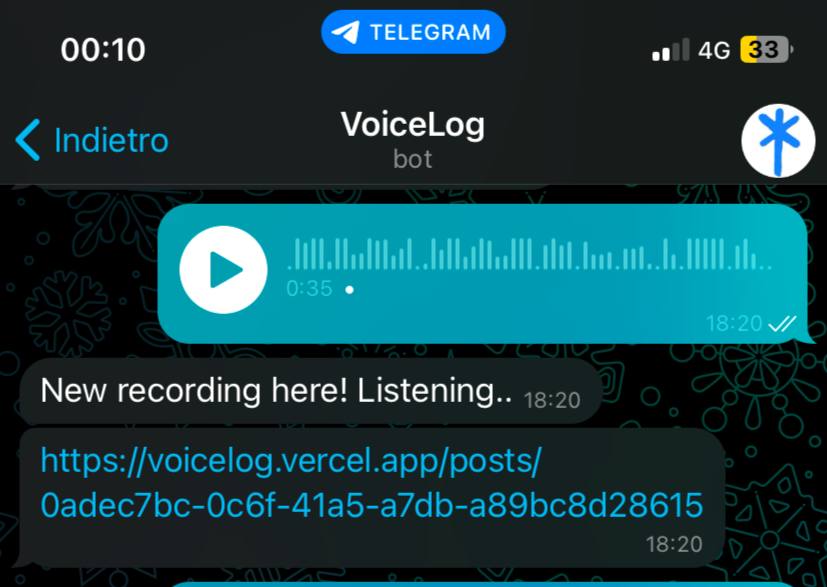
<p>I would talk, talk, talk, talk, and then I would give this audio to a speech-to-text model that would then be reformatted a bit to make it into a blog post. I did this with <a href="https://voicelog.vercel.app/">VoiceLog</a>, a product I created a year ago that allows you to do exactly this—it creates a preview of a blog post from a Telegram audio. Then I took a step further in the sense that speech-to-text models have improved a lot, and now my workflow for creating blog posts is a bit different.</p>

<p>I use <a href="https://superwhisper.com/">Super Whisper</a>, which has a great ability to understand what I’m saying and synthesize it well. Then I use a minimum of AI to correct those small spelling things or, I don’t know, when I talk about a product, to put the right links, I do a bit of post-processing, and then with my blog, with this blog you’re reading, I go to publish and I publish the post.</p>

<p><img src="/assets/images/blog/superwhisper.png" alt="Super Whisper Interface" /></p>

<p><em>me “writing” this blog post</em></p>

<h3 id="why-this-works">Why This Works</h3>

<p>This, in my opinion, is a very beautiful way to use AI to be authentic. It’s in the sense that through speech you’re as authentic as possible—you can’t read in the blog post when maybe I go from one topic to another, or maybe when while I’m talking I focus on something that particularly interests me, which is an expression of me, in fact, an expression of the content I want to give. With post-processing I don’t distort the content, I only correct spelling or format it, and so it comes out as a really very human discourse.</p>

<h2 id="the-result-fighting-ai-with-ai">The Result: Fighting AI with AI</h2>

<p>The beauty of this approach is that it leverages my natural communication style. As someone who enjoys talking and can articulate complex ideas in a single flow, I can now create content that feels genuinely human while still being efficient. What used to take an hour of careful writing now takes just 20 minutes from thought to publication.</p>

<p>Here’s the timeline: I started recording this audio at 3:50 PM on Sunday, June 22nd. By 4:10 PM, it was live on my blog. Twenty minutes total—from voice to published post.</p>

<p>The irony is perfect: we’re using AI to combat the very problem AI created. While AI-generated content threatens to make the internet feel artificial and soulless, we can harness AI’s speech-to-text capabilities to preserve human authenticity. It’s fighting fire with fire, but in the best possible way.</p>]]></content><author><name>donadev</name></author><category term="blog" /><category term="ai" /><category term="authenticity" /><category term="content-creation" /><category term="voice-to-text" /><category term="technology" /><summary type="html"><![CDATA[How I use AI to create authentic content through voice-to-text, fighting against the dead internet theory]]></summary><media:thumbnail xmlns:media="http://search.yahoo.com/mrss/" url="https://www.luigidonadel.com/assets/images/ai-authenticity.jpg" /><media:content medium="image" url="https://www.luigidonadel.com/assets/images/ai-authenticity.jpg" xmlns:media="http://search.yahoo.com/mrss/" /></entry><entry><title type="html">On Marketing and Patience: A Developer’s Journey</title><link href="https://www.luigidonadel.com/on-marketing-and-patience/" rel="alternate" type="text/html" title="On Marketing and Patience: A Developer’s Journey" /><published>2025-06-04T22:48:00+00:00</published><updated>2025-06-04T22:48:00+00:00</updated><id>https://www.luigidonadel.com/on-marketing-and-patience</id><content type="html" xml:base="https://www.luigidonadel.com/on-marketing-and-patience/"><![CDATA[<p>Marketing has been teaching me something unexpected about myself: <strong>I lack patience</strong>.</p>

<p>As a developer, I’m used to a linear process. When you’re coding, if something doesn’t work, there’s always a deterministic reason behind it. You can use logic to figure it out, fix it, and move on. You add one feature, then another, then another, and gradually build your product. Design works similarly - you add an element to your site or app, tweak it until it looks right, and you’re done. These are all linear processes where you get immediate feedback and can iterate based on that feedback.</p>

<blockquote>
  <p>But marketing? That’s a whole different beast.</p>
</blockquote>

<h2 id="the-content-machine">The Content Machine</h2>

<p>For <a href="https://easypapiro.com">Easy Papiro</a>, a project I’ve mentioned before on this blog, we’re creating tons of content. We’re making short-form videos for Instagram, TikTok, and YouTube Shorts - my co-founder and I have created about 45-50 pieces of content that we publish daily. On top of that, I’m writing and managing <a href="https://easypapiro.com/blog">Easy Papiro’s blog</a>, specifically targeting our users’ use cases.</p>

<p>All of this content is created for marketing purposes, to reach our end users. For social media, we’re aiming for viral content. We publish and watch which pieces gain traction, which ones attract more people. For the blog posts, we’re targeting specific Google queries that we know are most relevant to our area of interest.</p>

<h2 id="the-reality-check">The Reality Check</h2>

<p>You can do all the research in the world - study successful formats on social media, analyze what’s worked for other pages, use SEO tools for keyword research - but here’s what I’ve learned: <strong>marketing is anything but linear</strong>.</p>

<p>Every time I’ve thought:</p>
<blockquote>
  <p>“This has to work - I’ve been consuming Instagram content for 10 years, I know this format works!” 
or 
“This blog post is exactly what someone would search for on Google to find our product,”</p>
</blockquote>

<p>I’ve been promptly disappointed. I’ve realized that for this type of product, I don’t actually know what hooks will work, even though I was certain I did.</p>

<h2 id="the-developers-dilemma">The Developer’s Dilemma</h2>

<p>I’ve been on social media for 10 years, watching new formats and trends emerge constantly. I thought I knew what worked. But it’s never that simple. It’s never linear. It’s never deterministic. As a developer, I try to model everything deterministically, but the truth is, we’re talking about masses of people. We’re shouting in a crowded square, trying to get people to notice our product, and there’s no deterministic way to figure out the best way to shout.</p>

<h2 id="the-answer-patience">The Answer: Patience</h2>

<p>So what’s left? How do you do this kind of work?</p>

<p>The answer is patience - something I’ve never had to cultivate as a developer. Patience that leads to consistency. The ability to keep publishing day after day, week after week, month after month - posts, content, videos, blog posts - accumulating your knowledge of what works. After maybe two weeks of mediocre view counts, that one piece of content you thought was just filler, that you never expected to become popular, suddenly takes off. And that’s exactly what happened to us.</p>

<p>Marketing, being not an exact science but rather a science dependent on infinite variables, is teaching me patience. It’s forcing me to cultivate it, to embrace the uncertainty, and to keep showing up day after day, even when the results aren’t immediate. And you know what? <strong>I’m starting to appreciate this lesson</strong>.</p>]]></content><author><name>donadev</name></author><category term="blog" /><category term="marketing" /><category term="patience" /><category term="personal-growth" /><category term="entrepreneurship" /><category term="content-creation" /><summary type="html"><![CDATA[How marketing taught me the value of patience and consistency in a world of instant gratification]]></summary><media:thumbnail xmlns:media="http://search.yahoo.com/mrss/" url="https://www.luigidonadel.com/assets/images/marketing-patience.jpg" /><media:content medium="image" url="https://www.luigidonadel.com/assets/images/marketing-patience.jpg" xmlns:media="http://search.yahoo.com/mrss/" /></entry><entry><title type="html">Do I want to do this, or do I have to do this?</title><link href="https://www.luigidonadel.com/are-you-really-enjoying/" rel="alternate" type="text/html" title="Do I want to do this, or do I have to do this?" /><published>2025-04-25T22:48:00+00:00</published><updated>2025-04-25T22:48:00+00:00</updated><id>https://www.luigidonadel.com/are-you-really-enjoying</id><content type="html" xml:base="https://www.luigidonadel.com/are-you-really-enjoying/"><![CDATA[<h1 id="the-balance-between-joy-and-discipline-finding-your-path">The Balance Between Joy and Discipline: Finding Your Path</h1>

<p>In recent months, I’ve been deeply contemplating the contrast between finding pleasure in what we do and maintaining discipline. The eternal question: <em>Do I want to do this, or do I have to do this?</em> Both aspects are crucial, yet there’s a fundamental difference between them.</p>

<h2 id="my-journey">My Journey</h2>

<p>I’ve always considered myself a highly disciplined person. I’ve undertaken numerous projects, diving into the world of technology since 2013, when I was just 15-16 years old. From that point forward, I’ve been creating projects, working for companies, winning national competitions, and achieving results that, while not entirely satisfying, are certainly noteworthy. I’ve worked as a freelancer, completed various projects, and collaborated with companies I believed in.</p>

<p>All of this started with a genuine passion. Technology has always been my path. From a young age, my father suggested I try programming, and when I did, I immediately fell in love with it. The ability to build something - whether it was my first HTML/CSS website about Pokémon (my passion at age 11) or more complex projects - was always driven by the simple fact that I enjoyed it.</p>

<h2 id="the-role-of-discipline">The Role of Discipline</h2>

<p>Then, for reasons I’m still exploring, discipline entered the picture. And it’s important that it did, because life isn’t linear. Not every day will you be excited to do what you love. It’s like sports - you might love the game, but some days you don’t feel like training. You’re tired, in a bad mood, or angry about something, but you still have to do it. Therefore, both elements are essential, and neither should dominate completely.</p>

<h2 id="the-obsession-trap">The Obsession Trap</h2>

<p>Recently, I’ve been reflecting on this balance and realized that in many areas of my life, discipline had become the only driving force - a strong, almost obsessive discipline. I was chasing results, sometimes at the cost of my well-being. The indie hacking is a fascinating field, but there’s one thing they don’t tell you (or that you don’t listen to when they do): it takes patience.</p>

<h2 id="a-recent-project">A Recent Project</h2>

<p>I recently started a project with a friend called <a href="https://easypapiro.com">EasyPapiro</a> (which I mentioned in this blog a month and a half ago). It seemed like one of those overnight success stories we all hear about - a sensible idea in a niche market with little competition and room for innovation. I thought, “We’ll create this project, and it’ll be an overnight success.” But that success hasn’t come yet, and that’s normal. In this world, you need patience, which, for me, conflicts with obsessive discipline.</p>

<h2 id="the-cost-of-obsessive-discipline">The Cost of Obsessive Discipline</h2>

<p>My obsessive discipline became a sacrifice - putting aside other aspects of my life for immediate results. When those results don’t come, it creates endless anxiety, stress, and pressure that can compromise other parts of your life.</p>

<h2 id="a-new-perspective">A New Perspective</h2>

<p>Recently, I had a conversation with a friend working on a project. When I asked what he wanted from life, he said, “Apart from success with projects, I want exactly the freedom I have now. I’m starting to appreciate it because I’m doing things I genuinely love, and while these things might lead somewhere in the future, I’m already enjoying what I want my life to be.”</p>

<p>This was eye-opening. For a significant part of my journey, I’ve been living in the future. “In the future, everything will be better. In the future, this project will explode positively. In the future, I’ll have lots of money and solve all other problems.” I’m starting to believe this isn’t how it works. When they say it’s about the journey, they’re right. If you’re in “grind mode” - super disciplined and obsessive - you’re not enjoying the journey, and you’re not really getting anything out of it.</p>

<h2 id="moving-forward">Moving Forward</h2>

<p>This post serves as a declaration: I want to start enjoying things again. I’ve begun to slow down to see if what I’m doing truly brings me joy or if I only like it because it might lead to a life-changing result. I’m tired of “eating shit” just because I want a result. Instead, I want to do beautiful things - things that, even if I don’t particularly feel like doing them, won’t torture me or stress me out just because they’re important for a result.</p>

<p>I want my projects to be creative outlets, perhaps for certain moods. A place of happiness and escape. This is what I want my future to be: a balance between creativity and discipline, between the joy of doing something and the commitment to do it well and see it through to completion.</p>

<p>An harmony between pleasure, commitment, and success - when possible.</p>]]></content><author><name>donadev</name></author><category term="blog" /><category term="joy" /><category term="discipline" /><category term="personal-growth" /><category term="work-life-balance" /><summary type="html"><![CDATA[Are you really enjoying this? Or are you too disciplined to stop sacrificing?]]></summary><media:thumbnail xmlns:media="http://search.yahoo.com/mrss/" url="https://www.luigidonadel.com/assets/images/markdown.jpg" /><media:content medium="image" url="https://www.luigidonadel.com/assets/images/markdown.jpg" xmlns:media="http://search.yahoo.com/mrss/" /></entry><entry><title type="html">Easypapiro</title><link href="https://www.luigidonadel.com/easypapiro/" rel="alternate" type="text/html" title="Easypapiro" /><published>2025-04-19T16:33:00+00:00</published><updated>2025-04-19T16:33:00+00:00</updated><id>https://www.luigidonadel.com/easypapiro</id><content type="html" xml:base="https://www.luigidonadel.com/easypapiro/"><![CDATA[<p><img src="/assets/images/projects/easypapiro/cover.png" alt="Easypapiro Demo" /></p>

<h3 id="overview">Overview</h3>

<p>Easypapiro is a project born from a very specific cultural need in Northern Italy. Here, there’s a beautiful tradition where friends create personalized graduation scrolls (papiro) featuring caricatures and stories for their graduating friends. However, this tradition often comes with its own set of challenges - disorganization, time constraints, and the pressure to create something meaningful.</p>

<p>Together with <a href="https://www.linkedin.com/in/cristian-bozzato-37260b1b6/">Cristian Bozzato</a>, we created Easypapiro to solve these problems. Our platform uses AI to generate caricatures and craft rhyming stories, making the papiro creation process much smoother and more enjoyable.</p>

<p>What makes this project particularly interesting is that it’s not just about the technical implementation. It’s been a journey of learning and growth, especially in the realm of SaaS marketing. We’re actively creating content across multiple platforms - Instagram reels, TikTok videos, YouTube content, blog posts, and even traditional flyer distribution. This hands-on experience with marketing has been incredibly valuable and has significantly contributed to my professional development.</p>

<p>The project represents a perfect blend of technology and tradition, using modern AI tools to preserve and enhance a cultural practice that’s dear to many Italian students.</p>

<h3 id="available-on"><strong>Available on</strong></h3>

<ul>
  <li><a href="https://easypapiro.com">easypapiro.com</a></li>
  <li><a href="https://instagram.com/easypapiro">Instagram</a></li>
  <li><a href="https://tiktok.com/@easypapiro">TikTok</a></li>
  <li><a href="https://youtube.com/@easypapiro">YouTube</a></li>
</ul>]]></content><author><name>donadev</name></author><category term="project" /><category term="nextjs" /><category term="ai" /><category term="marketing" /><category term="saas" /><summary type="html"><![CDATA[An AI-powered platform that revolutionizes the traditional Italian graduation scroll (papiro) creation process.]]></summary><media:thumbnail xmlns:media="http://search.yahoo.com/mrss/" url="https://www.luigidonadel.com/assets/images/projects/easypapiro/logo.png" /><media:content medium="image" url="https://www.luigidonadel.com/assets/images/projects/easypapiro/logo.png" xmlns:media="http://search.yahoo.com/mrss/" /></entry><entry><title type="html">2024, the year I rediscovered my passion for building things.</title><link href="https://www.luigidonadel.com/2024-yearly-review/" rel="alternate" type="text/html" title="2024, the year I rediscovered my passion for building things." /><published>2025-02-22T22:48:00+00:00</published><updated>2025-02-22T22:48:00+00:00</updated><id>https://www.luigidonadel.com/2024-yearly-review</id><content type="html" xml:base="https://www.luigidonadel.com/2024-yearly-review/"><![CDATA[<p>2024 was a very important year for me.</p>

<p>I was coming from a difficult period professionally - after years of trying to scale my career in startups, I had lost the spirit that once drove me to build products on my own. I had lost faith in a future where I could be an entrepreneur, and I was slowly wearing myself down on a path that, although full of achievements, wasn’t truly mine.</p>

<p>In 2024, I got back up and built various projects that laid the foundation for what should become my entrepreneurial journey.</p>

<p>It wasn’t easy. 10 years ago, I started my entrepreneurial path building various apps because in high school, during an iOS development course, I heard the instructor say: <em>“in the app economy, there are lots of young people who make an app and wake up the next day with sales.”</em> He was trying to sell us on the idea that “they wake up millionaires,” but the concept was that you could aspire to a future where you didn’t depend on anyone.</p>

<p>Over the years, doing various jobs between freelance consulting for companies and startup work that led me to become Mobile Lead, I had lost this vision. I no longer believed it was possible, so I had stopped putting effort into building things.</p>

<p>Projects like <a href="/foodlist"><strong>Foodlist</strong></a> and <a href="/triviapatente"><strong>TriviaPatente</strong></a>, projects of my past completely bootstrapped by myself and a few friends, were pieces of my experience that were becoming distant memories.</p>

<p>Until <a href="https://antonioterpin.com">Antonio</a>, a friend of mine, whom I deeply respect and who has always been a source of inspiration over the years, convinced me to make a switch with a simple challenge: <em>“Build a service, anything, in a weekend.”</em> This service was <a href="/eli5">ELI5</a>, a very simple service I’ve written about on this blog, but it came from a need I had seen in some of my friends: explaining concepts in super simple terms for studying for university exams.</p>

<p>So I tried it, and although it was a small and time-boxed experience, I remember it very fondly. 
With that project, I rediscovered my passion for building things. I learned Next.js, Tailwind, and I started building GPT wrappers for fun.
It was exactly a year ago, but if I hadn’t written that small piece of software for myself and my creativity, I would never have built the other projects I made in 2024, like <a href="/cardsgpt">CardsGPT</a> (built in collaboration with Antonio), and especially <a href="/qabuddy">QABuddy</a>.</p>

<p>Let’s say 2024 was the year I woke up. I have significant technical expertise, <strong>I’ve been living on code for 10 years and I’m still passionate</strong>. I have an important competitive advantage - I’ve developed all sorts of things in both consulting and startup contexts, always in what you might call ‘Founder mode’, in my own way.
This has led me to be able to build virtually any project I can think of. And this is a huge competitive advantage that I’ve rediscovered.</p>

<p><strong>This is definitely what I hold most dear from 2024.</strong></p>

<p>2024 was also much more, other experiences that enriched me in their own way.
It was the year when, after 2 years, I left Milan. I moved to live alone in a small town in eastern Italy, and I took home all the life experiences that changed me tremendously. When I decided, two years ago, to move to Milan, I was looking for something that was probably myself, and I came back with a much clearer purpose.</p>

<p>There’s a lot of talk about ‘<em>agency</em>,’ well I think I developed it a lot through this experience.</p>

<p>2024 was also the year I ended a relationship with a girl who helped me grow a lot. We often tend to talk about profession, career, success, but life also includes this. <strong>Relationships and emotions.</strong></p>

<p>A relationship for which we both sacrificed a lot, but unfortunately didn’t work out. It was the year when, thanks to this relationship, I understood various things about myself. I’ve been going to therapy for 3.5 years now but I honestly think this was the most valuable year at that level. We often tend to analyze ourselves through numbers, facts, and objectives, but I discovered the importance of analyzing my emotions. Being rational, we always try to optimize to control our emotional state, but sometimes it simply escapes, does stupid things, suffers when you’d tell yourself ‘<em>why suffer?</em>’. Uncontrollable things. I learned to let these things happen inside me, let them vent, and note them down.</p>

<p>I started <strong>writing for myself</strong>, noting how I feel, how I react, to understand exactly the feelings that fill me when I don’t understand them. I’m still doing it today, writing more or less every day my thoughts on <a href="https://mindsera.com">Mindsera</a>.
I believe this blog that I’m starting to build is a natural evolution of this process, where I want to share all the steps I’m overcoming in my journey to becoming an entrepreneur.</p>

<p>If I had to summarize this year in two things I learned, they are:</p>
<ul>
  <li>If you have an entrepreneurial goal, even if you don’t see immediate results, <strong>build and continue building blocks</strong>, sooner or later (hopefully), the results will come. (A lot of theory suggests this every time, but it was never as clear to me as when I went through it myself)</li>
  <li>You are your best ally, but if you don’t manage yourself well, your fears become your worst enemies. I have a lot of fears, it’s completely normal and human. They’re not weaknesses, they’re just part of being human. Write down what you want to do when you’re feeling good, and reread those things when you’re struggling. <strong>Agency is built this way too.</strong></li>
</ul>

<p>We’re ready for a constructive 2025, with these two additional solid foundations.
I started 2024 without them, now I have them, and I feel like a 27-year-old ready to take on the world for my future.</p>]]></content><author><name>donadev</name></author><category term="blog" /><category term="yearly-review" /><summary type="html"><![CDATA[2024, the year I rediscovered my passion for building things.]]></summary><media:thumbnail xmlns:media="http://search.yahoo.com/mrss/" url="https://www.luigidonadel.com/assets/images/markdown.jpg" /><media:content medium="image" url="https://www.luigidonadel.com/assets/images/markdown.jpg" xmlns:media="http://search.yahoo.com/mrss/" /></entry><entry><title type="html">DataCanvas.live</title><link href="https://www.luigidonadel.com/datacanvas/" rel="alternate" type="text/html" title="DataCanvas.live" /><published>2025-02-10T16:33:00+00:00</published><updated>2025-02-10T16:33:00+00:00</updated><id>https://www.luigidonadel.com/datacanvas</id><content type="html" xml:base="https://www.luigidonadel.com/datacanvas/"><![CDATA[<p><img src="/assets/images/projects/datacanvas/cover.png" alt="DataCanvas Demo" /></p>

<h3 id="overview">Overview</h3>

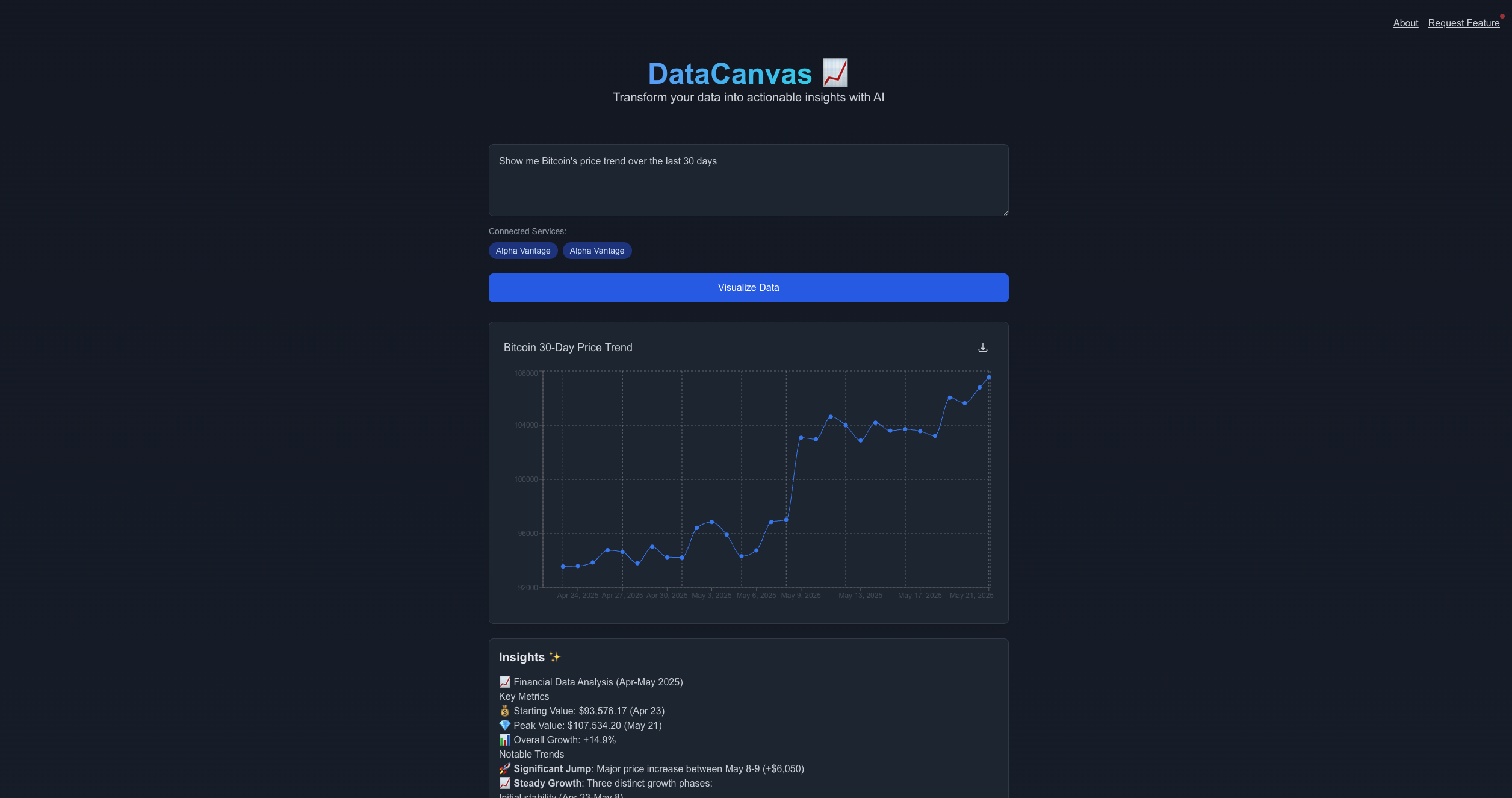
<p>DataCanvas is a web application that helps users get data from various sources and visualize it. Instead of writing code to fetch and process data, you can describe what you want in plain English, and the application will:</p>

<ul>
  <li>Convert your request into the necessary API calls</li>
  <li>Fetch the data from the specified source</li>
  <li>Create a visualization of the results</li>
  <li>Add a brief explanation of what the data shows</li>
  <li>Handle private APIs by requesting API keys when needed</li>
</ul>

<p>The main goal is to simplify the process of getting and visualizing data, especially for those who aren’t comfortable with programming or API integration. The application can work with both public and private APIs - when it detects that a private API is needed, it will simply ask the user for their API key to access the data.</p>

<h3 id="tech-stack"><strong>Tech Stack</strong></h3>

<p>The application is built with:</p>

<ul>
  <li><strong>Frontend</strong>: Next.js</li>
  <li><strong>AI Services</strong>:
    <ul>
      <li>Perplexity API for understanding user requests</li>
      <li>OpenAI API for data analysis</li>
    </ul>
  </li>
  <li><strong>Data Handling</strong>: Next js backend</li>
  <li><strong>Hosting</strong>: Vercel</li>
</ul>

<h3 id="available-on"><strong>Available on</strong></h3>

<ul>
  <li><a href="https://datacanvas.live">DataCanvas.live</a></li>
</ul>]]></content><author><name>donadev</name></author><category term="project" /><category term="nextjs" /><category term="ai" /><category term="charts" /><summary type="html"><![CDATA[Visualize chart for any data from the web, using natural language queries.]]></summary><media:thumbnail xmlns:media="http://search.yahoo.com/mrss/" url="https://www.luigidonadel.com/assets/images/projects/datacanvas/logo.svg" /><media:content medium="image" url="https://www.luigidonadel.com/assets/images/projects/datacanvas/logo.svg" xmlns:media="http://search.yahoo.com/mrss/" /></entry></feed>